A family booked a week in Carillon Beach through VRBO earlier this year, paid in full, and only found out after arrival that reaching the pool or the beach required a separate pass purchased through an email link that never appeared during booking. Two of the three pools they expected to use were closed. The walkover code for daily beach access had to be picked up at the gatehouse each morning. None of it showed up in the listing. It showed up afterward, in guest reviews from renters describing the same surprise in back to back months this year, one in February and another in March.
That is an inconvenience for a renter. For someone evaluating Carillon Beach as a purchase, it is something more useful: a live example of how a gated, amenity-rich community can add cost and friction to ownership after closing, in ways a listing sheet never mentions.
The Pass Is New. The Question Behind It Isn't.
Starting this year, Carillon Beach began requiring a QR code to enter the pool gates and the beach walkovers, with a $35 fee attached per party. The community sends an email link ahead of a stay so guests can purchase the pass before they arrive, at least in theory. That is worth noticing not because $35 is a large sum on its own, but because it is proof that the Carillon Beach Association can add a new access requirement to amenities that were already built and already funded through decades of dues. If the Association could layer in one new gate fee this year, the honest question for a buyer is what governs the next one, and whether it shows up on a listing sheet before or after the offer is signed.
What Sits Behind The Gate
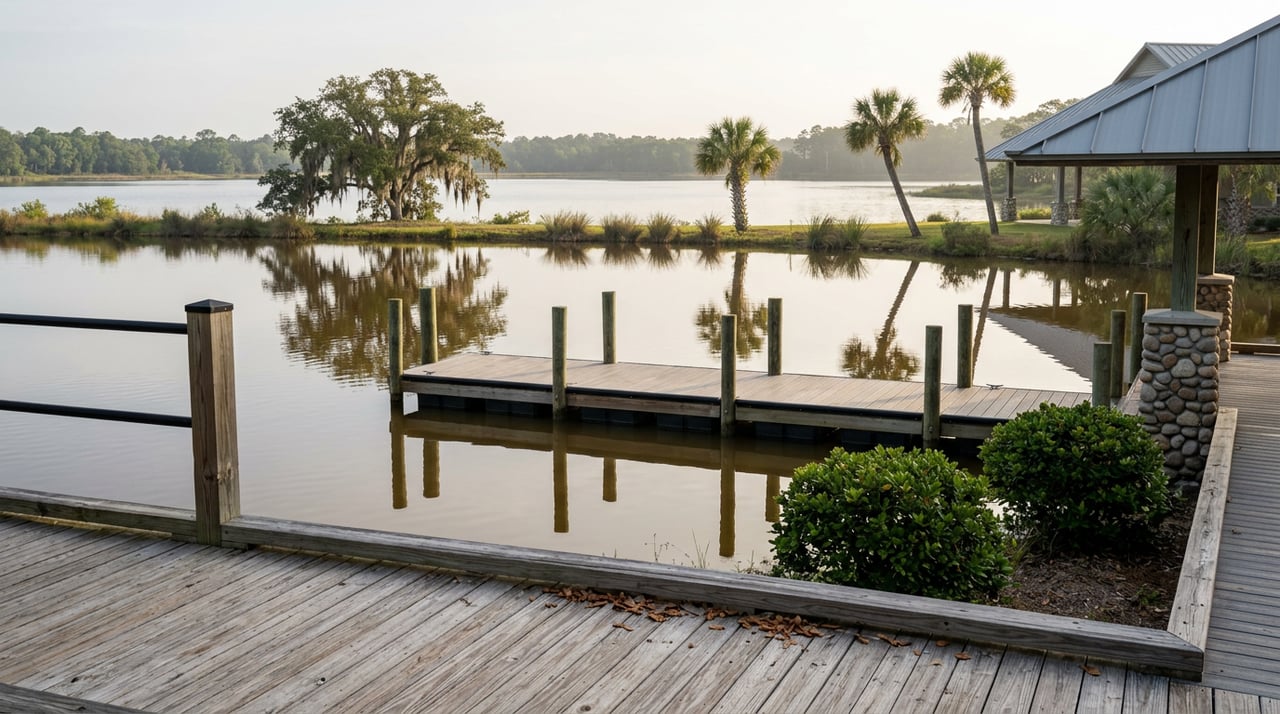
The amenities being gated are not small. Carillon Beach covers roughly 104 acres and includes more than 3,900 linear feet of gulf beach frontage. Four pools are spread through the community: the Beach Club Pool near the shoreline, the Lake Carillon Pool at the eastern edge of the village, Bellview Park Pool with its own children's pool and pool house, and a Resort Pool reserved for owners of the Sunrise and Sunset condominiums and the Carillon Beach Inn. Several of these are heated from November through May. Two hot tubs sit within the resort pool area, and the community also has tennis courts, a pickleball court, and a lighted basketball court.
The village borders Lake Powell, the largest coastal dune lake in Florida and one that carries a Pristine Florida Waterway designation, along with its own 13 acre Lake Carillon at the center of the property. Market Street anchors the pedestrian core with an ice cream parlor, a breakfast cafe, a yoga studio, bicycle rental, a spa, and a fitness center, plus a scattering of local restaurants nearby including Lakehouse, Bayou Bill's Crab House, and Bubba's Pizza. The 50 foot Carillon Bell Tower chimes on the hour from 8 a.m. to 8 p.m., a detail that shows up in nearly every description of the community because it genuinely is the thing you hear most days.
This is a lot of infrastructure, and none of it is new. The $35 pass is not funding new construction. It is a new charge layered onto assets the Association has maintained for years.
The Fee Stack A Listing Sheet Won't Show You
Quarterly assessments are levied against every lot and home in Carillon Beach to fund daily operations, based on the Association's own budget filings. On top of that, the Association charges a $250 estoppel fee due at closing, standard practice for confirming a seller's account is current before a transaction closes, but a real line item to budget for specifically here. And now there is the $35 amenity pass, tied not to ownership but to actual use of the pools and walkovers, a fee that did not exist before this year.
Three different charges, three different triggers. Quarterly assessments recur on the Association's schedule. The estoppel fee lands once, at closing. The amenity pass is tied to each stay or reservation. None of that fits neatly into the single "HOA fee" line a portal listing typically shows, which means a buyer working from that number alone is working from an incomplete one.
Why This Matters More In A Softening Market
Panama City Beach's median sale price sat at roughly $384,000 over the three months ending May 2026, down about 4.1 percent from the same period a year earlier, with homes taking an average of around 106 days to sell. Public market tracking earlier this summer put local supply well past the six month mark that typically defines a buyer's market. That combination gives buyers something they didn't have a few years ago: time.
In a faster market, buyers skip due diligence to win a multiple offer situation. In this one, there is room to actually request the current Association budget, ask for a reserve study, and get the fee history in writing before making an offer, rather than after. The softening price is exactly the moment to spend that extra time, not the moment to assume a lower asking price means a simpler ownership picture. In a community like Carillon Beach, price is only one part of what a buyer takes on.
What To Ask Before You Write An Offer
- Request the current Carillon Beach Association budget and the most recent reserve study, not just the quoted quarterly assessment
- Ask for the last three years of any new amenity, gate, or access fee, not only what's charged today
- Confirm in writing whether the $35 pass applies to owners the same way it applies to renters and guests, since that detail isn't uniformly published
- Ask specifically which pools are heated November through May and whether any have had extended closures
- Confirm who customarily pays the $250 estoppel fee in a Carillon Beach purchase contract, buyer or seller
- Ask how walkover access works for a full time resident versus a unit that will be rented out
For buyers who would rather skip this kind of fee stack altogether, some nearby Panama City Beach neighborhoods trade the resort infrastructure for a simpler association structure and fewer built amenities. That is a legitimate trade, and it's worth naming even though this piece isn't the place to rank one option over the other. The point isn't that Carillon Beach is a bad buy. The point is that the real cost of owning here is layered, and the listing price was never going to show you all of it.
A Few Questions Worth Asking Directly
Is the $35 amenity pass a one-time charge or something that repeats? Rental sites describe it as tied to each stay or reservation for guests. Owners should confirm directly with the Association whether the requirement works differently for full time residents.
How is the estoppel fee different from the amenity pass? The $250 estoppel fee is a one-time closing cost that confirms a seller's assessment account is current. The amenity pass is a recurring access fee tied to actual pool and beach use, unrelated to the sale itself.
Does every home pay the same quarterly assessment? Assessments are set per lot and home under the Association's declaration, and the exact figure varies by budget year. The safest approach is pulling the current budget rather than relying on a number quoted in a listing.
If you're weighing Carillon Beach against another stretch of Panama City Beach, or you just want the full fee picture before you write an offer, Beach King Realty can walk through the current Association documents with you and help you price the real cost of ownership, not just the list price. Schedule a free consultation and let's look at the numbers together before you're the one signing at closing.