"First of all, we don't know whether the property is private. We don't know whether you actually have legal guardianship of it. We don't know what the legal boundaries of the property are," Walton County Sheriff Michael Adkinson Jr. told NPR in September 2026. He said his office is getting more beach-dispute calls than ever.
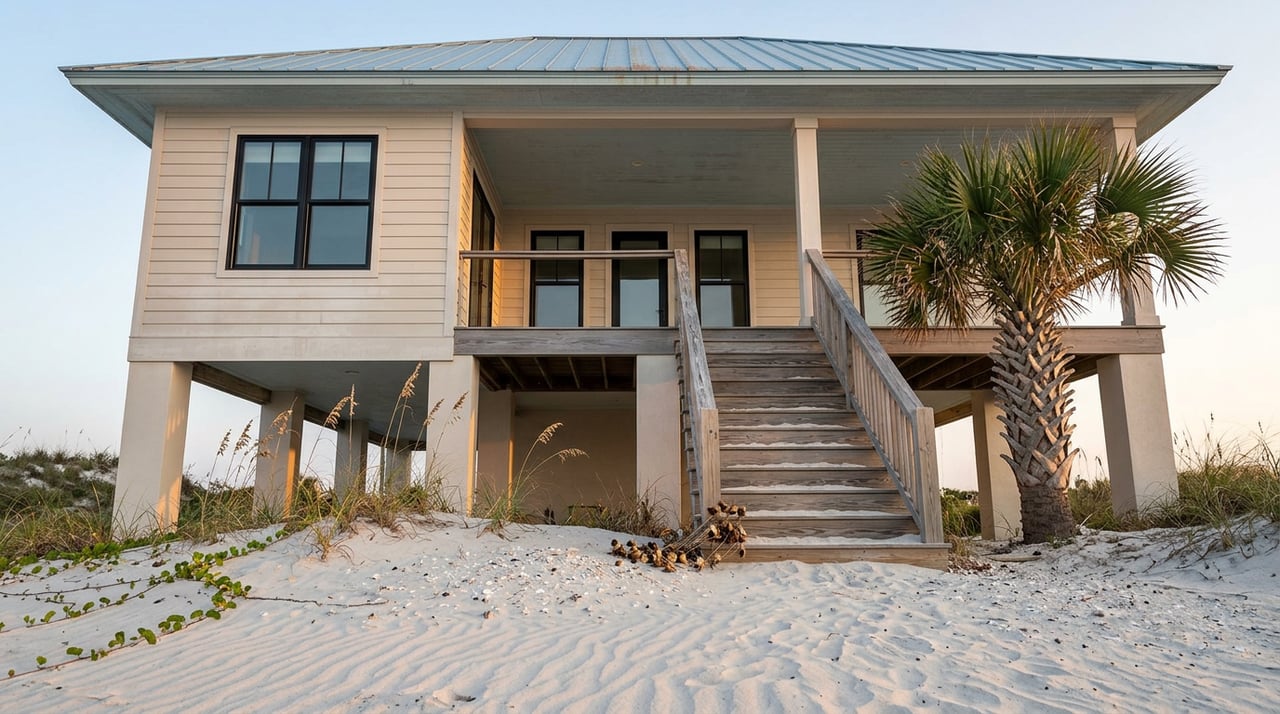
His answer bears on anyone buying a Gulf-front home in Inlet Beach. In Walton County, the dry sand behind a house may well be private. Whether a deputy will treat it as private depends on whether the owner can produce a short list of recorded documents. Two homes on the same stretch of shoreline can look the same in a listing and still carry very different practical rights on the beach. The difference is a file, and buyers can ask for it before closing.
The File A Deputy Asks For
The Walton County Sheriff's Office spells out the requirements in SOP 2.1.1, which took effect October 1, 2023. If the public-record title owner wants trespass enforced on Gulf-front property, deputies need these documents, and the officer keeps them as evidence:
- A copy of the owner's deed. A certified copy is preferred, and the Walton County Clerk's office at the South Walton Annex can provide one.
- A copy of the plat, if the property sits in a platted subdivision or condominium.
- The owner's driver's license, matching the name on the deed. If the property is held by an LLC, trust, corporation or partnership, the owner also needs a resolution signed by all principals authorizing that person to act.
- A signed, sealed and certified survey that FDEP has approved and that establishes the mean high-water line. The survey must be recorded with the Walton County Clerk and must show all linear dimensions of the property boundary.
- Boundaries marked on the ground between the mean high-water line and the upland property.
Item four trips people up most often. The policy itself says FDEP does not require linear dimensions on an approved mean high-water survey, so an owner can hold an approved, recorded survey that still falls short. In that case the SOP says the owner has to have a surveyor update it. The policy does allow two exceptions. If the person is far enough from the wet sand that the other documents make the owner's property obvious, a signed and sealed survey without FDEP approval will do. And if the officer can readily determine the boundaries, the officer may proceed even without markings on the ground. Neither exception helps with the disputes closest to the waterline, which is where the approved survey earns its place in the file.
Item three matters for second-home buyers, because many of them hold title in an LLC or trust. If the beach is common area dedicated to an HOA or condominium association, a board resolution or trespass authorization letter is required too. Renters and guests can ask for enforcement only with all of the above plus an authorization letter from the owner. A vacation-rental owner who wants guests to have the same footing as the owner needs that letter ready before the first booking.
Even with a complete file, the process starts slowly. A Beach Community Service Officer is dispatched first and tries to resolve the situation. A deputy is called only if that fails, and from there a warning, citation or arrest is at the deputy's discretion. Adkinson told NPR he doesn't think his office has made an arrest for beach trespassing in a decade.
Which Rules Apply To An Inlet Beach Parcel
The SOP sorts Gulf-front property into three situations. Each one puts the enforceable line in a different place.
| Parcel situation | Where deputies stop enforcing | Public use allowed |
|---|---|---|
| Party to the county's customary-use settlement | Owner's property line, plus a transitory zone | 20-foot zone: walking, water access, personal chair or towel from 9 a.m. to 4 p.m., one person per five feet |
| Not in the settlement, no established erosion control line | Seaward of the wet sand or the mean high-water line | Wet sand below the line |
| Nourished beach with an established erosion control line | Seaward of the erosion control line | Everything seaward of the line |
For most Inlet Beach Gulf-front parcels, the middle row is the likely default. The SOP's erosion control line section names a specific stretch, from Topsail Hill Preserve State Park west to the Okaloosa County line. Inlet Beach sits at the opposite end of the county. Walton County's erosion control line GIS layer, whose data was last supplied in 2019, maps its line well west of the Seacrest-to-Inlet reach. The layer warns that it is approximate and does not show what may have been recorded since, so a recorded survey and a records search are the legal check.
The settlement row is the exception you have to check parcel by parcel. In 2023, WMBB reported that about 39 beachfront owners had settled, while about 1,100 other properties were treated as private. County minutes from June 2023 put the case at 1,194 private properties. We found no public list showing whether any settled parcel is in Inlet Beach. The title search is where that question gets answered.
What The February Ruling Did And Did Not Settle
The legal backdrop changed twice in 2025 and 2026. On June 24, 2025, Governor DeSantis signed Chapter 2025-178. It repealed section 163.035, the 2018 statute that required counties to go to court to prove customary use.
Walton County had already used that statute. It filed suit in December 2018 and won a circuit court judgment in February 2024 that declared a limited public right of customary use on the dry sand of the remaining parcels. On February 18, 2026, the First District Court of Appeal dismissed the owners' challenge, and both sides agreed the judgment was a nullity once the statute was repealed.
The opinion leaves several things open. The county told the court the repeal put the parties back at "square one." It also said it still considered its 2017 ordinance invalid and believed it could adopt a new ordinance under home-rule power. The property owners argued the recorded judgment acted as a cloud on their title. The court called that harm hypothetical and did not rule on the merits. The Board of County Commissioners' May 12, 2026 agenda listed a "Resolution on Customary Use" from Commissioner Danny Glidewell. We could not find a recorded outcome.
For a buyer, this means two questions for the title attorney. First, does the recorded 2024 judgment appear in the chain for this parcel? Second, how does the title insurer treat it now that an appellate court has called it a nullity? NPR also reported that some landowners have gone to court for quiet title to the sand behind their homes. A completed quiet-title action on a specific parcel is worth asking about too.
An Erosion Control Line That Isn't On The County Map
The same 2025 law has a second provision that matters more at Inlet Beach than at most of 30A. In Florida's most recent critically eroded beaches report, dated August 2025, FDEP lists Walton County's Reach 5, Seacrest Beach to Inlet Beach, as a 4.2-mile segment running from range monument R105.5 to R127.4.
Chapter 2025-178 lets FDEP restore critically eroded beaches named in its August 2024 report without a public easement, in counties that include Walton. It sets the erosion control line at the mean high-water line as surveyed by the state's Board of Trustees. Where a critically eroded shoreline has no erosion control line, the Trustees must adopt one by resolution and record it, and any sand added seaward of the line stays state sovereignty land. We confirmed Reach 5 in the August 2025 report. Whether it appears in the August 2024 report the statute cites is a question for FDEP.
If a restoration project ever reaches this shoreline, a recorded erosion control line would move the parcel into the third row of the table, and deputies would not enforce trespass anywhere seaward of that line. Nothing like that is scheduled yet. FDEP's January 2025 funding plan does not list Walton County among the restoration projects requested for FY 2025-26 or projected for FY 2026-27. The county's earlier federal storm-damage reduction effort stalled because too few owners signed construction easements, and a 2022 proposal needed a contiguous mile of participating beachfront to move forward. Anyone buying a long-term hold here should keep an eye on whether that changes.
The Public Side Of The Same Shoreline
Walton County's access chart lists three Inlet Regional Beach Access points. The East and West accesses are on W Park Place Ave, and the Central access is at 139 S Orange St. The tourist development council's parking guide counts about 10 to 12 spaces at the East lot and 50 at each of the other two. Walton County's paid-parking program began April 3, 2026, but its FAQ names only the Van Ness Butler, 393 Municipal and Grayton Beach Municipal lots, so the Inlet lots are not on the paid list.
For a home near those accesses, public foot traffic on the wet sand is a given. How much of the dry sand stays the owner's in practice comes back to the file. The Visit South Walton access map was last updated September 21, 2026 and is useful for orientation. It says plainly that it is not a legal representation.
The wider debate is still going. Dave Rauschkolb of Florida Beaches for All is backing a state constitutional amendment to guarantee public beach access. Attorney Kent Safriet, who represented about 80 landowners, argues customary use conflicts with the Fifth Amendment. We found no petition signature totals or target ballot year.
What To Request Before You Close
- A copy of any recorded, FDEP-approved mean high-water line survey, and confirmation that it shows linear boundary dimensions
- Confirmation of whether the parcel was a party to the Walton County customary-use settlement agreement
- A title review covering the recorded February 2024 judgment and any quiet-title action
- If the seller is an entity or association, the authorizing resolution the SOP requires
- A surveyor's opinion on whether any erosion control line has been recorded for the parcel
Sellers can turn the same list into an advantage. A Gulf-front listing that comes with a current recorded survey, clear settlement status and a clean title history answers a buyer's attorney before anyone asks. That shortens a due-diligence period that otherwise tends to drag.
Two Questions That Come Up Often
Did the 2025 law make Inlet Beach's dry sand public? No. It repealed the customary-use statute, and the February 2026 ruling treated the judgment that statute produced as a nullity. The law also states that the state has no intention of depriving upland owners of the lawful use of their property.
Could the rules change again? The county told the appeals court it believes it can adopt a new ordinance. As of this writing, we found no adopted replacement.
Nothing here is legal advice. Before you commit, confirm each item with a title attorney and a licensed surveyor.
If you're weighing a Gulf-front home in Inlet Beach, or getting one ready to list, Beach King Realty can help you pull the survey, settlement status and title questions together early, so the beach behind the house is documented before the offer is written. Schedule Free Consultation.